Eulogy for Florence Levine
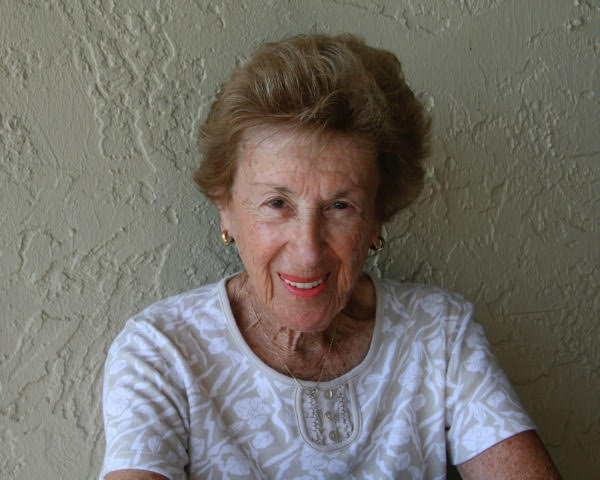
Hi everyone. I'm a little uncomfortable making these remarks. It's mostly my pants. They're way too small for me. The thing is, I knew the pants of my one nice suit were too small for me, I've known it for years. These last few weeks, I could hear Florence, who I called Nana, as a little voice in the back of my head saying, “Don't leave it for the last minute, why do you always leave everything for the last minute?” She was right.
Florence was sharp. Her mind had been honed by hundreds of detective and spy novels and an even larger number of real world social conundrums. She could have given Ms. Marple a run for her money and don't even talk to me about Hercule Poirot and his absurd little grey cells. Florence would have left him in the dust. I hope you don't think from my use of Agatha Christie detectives as measuring sticks that I'm suggesting Florence was stuck in the past. On the contrary, she was a resolutely modern woman. No shrinking violet, she enjoyed the Sopranos and Breaking Bad every bit as much as Casablanca and The Big Sleep. And just two days ago, a Netflix disc from Orange is the New Black showed up at the house! You would think Florence's agile mind had been designed specifically for solving crossword puzzles if you hadn't seen it work with people. When it came to identifying a person's character, she was fast and accurate. In conversation, this quality could be disconcerting. Although I knew my Nana's love was unconditional, it was not blind. If you've ever been on the wrong end of one of Florence's incisive remarks, you know what I'm talking about. Florence was remarkably good at identifying when my brother and my jokes had moved from harmless to harmful and effective at forcing a truce, especially if my Mom had been the target. The vast majority of the time, Florence used her intelligence and quick thinking to help solve problems, to make people laugh, and most of all, to enjoy life.
On the bus down from Boston, I was reading a sci-fi book and a passage caught my eye. It's a quote about the nature of family through the eyes of a spaceship pilot named Alex. “Alex's experience of real family - of blood relations - was more like having a lot of people who had all wound up on the same mailing list without knowing quite why they signed up for it.” I love the idea of family feeling like an inexplicable mailing list. It rings true to me about many of the families I know. Not ours. In our family, we all know why we signed up for the mailing list: Florence.
In many ways, large and small, Florence was the architect of our family.
She was the driving force behind our tradition of getting together each year on Thanksgiving. She hosted for the first 30 some years and cooked for almost 20 of them. Florence was the one who people kept in touch with during the year and she who kept us coming back together in November. We take it for granted but in many families second cousins barely know each other. In ours, they are as close as first cousins.
Another wonderful thing about Florence was her ability to connect in a unique way with so many people. And such different people as well. In my parent's generation of our family, we have school teachers, business people, and craftspeople. In my generation, we have an accountant, entrepreneurs, a musician, a writer, a filmmaker, a visual artist, and every combination of people you can imagine. In our growing next generation, we have people interested in everything from soccer and baseball to trumpet and drooling. One of them is very young.
Florence connected with everyone equally and uniquely. We all felt we had a special relationship with her based on a shared love for something. If you stop and think about it, that's pretty amazing. What kind of person can manage doing that? Just international spies and Florence.
Florence lived life the way she wanted to live. She was capable and independent, living alone until just six weeks before her death. I know that's the way she wanted it. A few years ago, we were eating at a restaurant in Florida, sharing the escargot that she often craved and basically only I would share with her, when an elderly woman walked by, very, very slowly, assisted at every step by someone who looked like her son. “I'm never going to be that way,” Florence growled at me. And you know what? She wasn't. Perhaps the finest testament to Florence's success in this realm is that the emotion so many of us felt when we heard she was sick, and even when we heard she died was surprise. Florence was so full of life and so thoroughly competent, that even at 91, it's hard to believe that she's gone. It's hard to believe we have to say goodbye.
Florence didn't like saying goodbye. “No goodbyes,” she'd say as we hugged and kissed in an airport or at a train station, or just before getting into a car. Lots of people share this habit of not saying goodbye. For many of them, it is a superstitious thing. Saying goodbye tempts the hand of fate. For Florence, I think it was an expression of her character. At her core, she was a relentlessly future oriented person. Saying goodbye was too much focusing on the past and frankly, for Florence, took too much time. Far better to part with a quick kiss and then move on to whatever came next.
Florence understood that each of us is different; a unique person with his or her own experiences and ways of handling things. None of us can control the way we mourn, just like none of us can control the way we die. Not even Florence. But I can't help but think, when I reflect on who Florence was, that the way her illness took her from living by herself to six weeks of convalescence to death was done at a very Florence-like pace. I imagine that if she were here today, she'd be in the moment, feeling sad, feeling mournful, but come tomorrow or the next day, she'd want to be on to her next project: reading a novel, creating art, binge watching some wholly ungrandmotherlike television show. None of us is her, and we don't have to mourn like her, but it's nice to know that no matter when the urge comes to move on with our lives, we'll know where it came from and we'll know it's okay.